Large video projects, photo libraries, backups, and creative files need more than a basic external drive. The right RAID enclosure can combine multiple disks into faster, higher-capacity, or more resilient storage while keeping your setup flexible.
We’ve selected 10 enclosures across two-, four-, five-, eight-, and 10-bay designs, including USB-C, USB 3.2, Thunderbolt, and eSATA options. Use the guide below to match capacity, performance, RAID features, and expandability to your workflow.
Best 10 Raid Enclosures for Large Files Picks for 2026
High-Capacity Speed Pick
ORICO 5-Bay 20Gbps RAID Enclosure
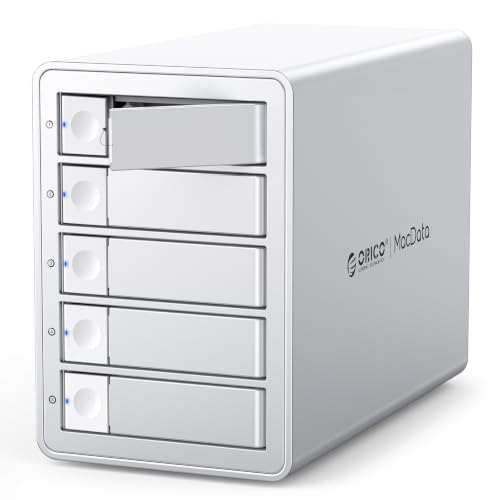
- Up to 130TB across five drives
- Six RAID and storage modes
- USB 3.2 Gen 2x2 with cooling fan
Best For: Professional multi-drive storage and large media libraries
Thunderbolt Performance Pick
OWC ThunderBay 4 Storage Enclosure

- Up to 1527MB/s sustained performance
- Four 3.5-inch or 2.5-inch drive bays
- Supports RAID 0, 1, 4, 5, and 10
Best For: Thunderbolt-equipped Mac and PC workstations
Balanced Two-Bay Choice
TERRAMASTER D2-320 USB RAID Enclosure

- Supports up to 44TB total
- RAID 0, 1, JBOD, and Single modes
- Tool-free trays with smart fan control
Best For: Compact direct-attached storage and mirrored backups
High-Capacity Value Pick
ORICO 4-Bay 88TB RAID Enclosure

- Up to 88TB across four drives
- Eight RAID, clone, and storage modes
- 235MB/s transfer rate with USB 3.0
Best For: Large archives, video footage, and flexible backups
Best Trayless JBOD Pick
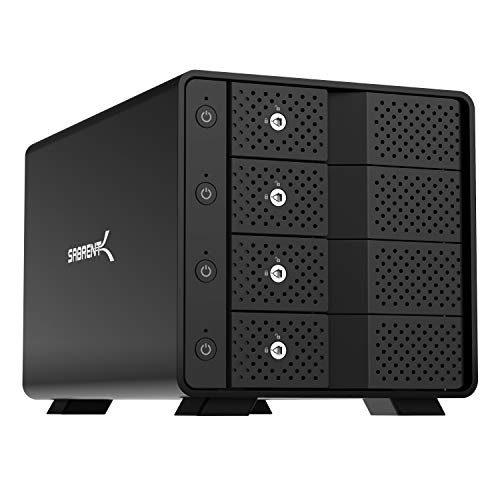
- Four independent 3.5-inch SATA bays
- 10Gbps USB-C connection
- Up to 80TB with active cooling
Best For: Simple high-capacity JBOD storage
Best Flexible RAID Value

- Seven listed storage modes
- Up to 96TB across four bays
- Dual switch-controlled cooling fans
Best For: Flexible RAID and backup storage
Best Five-Bay Capacity
Yottamaster 5-Bay RAID Enclosure

- Five bays and up to 110TB
- Supports 2.5-inch and 3.5-inch SATA drives
- RAID, JBOD, and Clone modes
Best For: Large media archives and video workflows
Best High-Capacity Pick

- Supports up to eight SATA HDDs or SSDs
- Offers eight RAID and storage modes
- USB 3.0, eSATA, aluminum body, and dual fans
Best For: Large desktop file libraries needing flexible eight-drive storage
Maximum Drive Count Pick

- Holds up to 10 SATA HDDs or SSDs
- Lists up to 200TB total capacity
- Includes eight modes, USB 3.0, and eSATA
Best For: Very large desktop archives requiring maximum bay capacity
Best Compact Option

- Supports four SATA HDDs or SSDs
- Offers up to 80TB and eight storage modes
- Compact aluminum design with USB 3.0 and eSATA
Best For: Smaller workspaces needing expandable multi-drive storage
High-Capacity Speed Pick – ORICO 5-Bay 20Gbps RAID Enclosure
For professionals handling large video projects, backups, or research datasets, this ORICO 5-bay enclosure is one of the more capable raid enclosures for large files. Its USB 3.2 Gen 2×2 connection, broad RAID support, and up to 130TB capacity are designed for demanding multi-drive storage.
Best For: Video editors, enterprise IT users, AI and research professionals, and anyone needing very high-capacity external storage.
Pros:
- Supports RAID 0, 1, 5, 10, JBOD, and Normal modes.
- Holds five 3.5-inch SATA drives, up to 26TB each and 130TB total.
- 20Gbps USB 3.2 Gen 2×2 interface improves large-file transfer efficiency.
- Includes a low-noise fan, aluminum construction, hot-swapping, and a built-in 150W power supply.
Cons:
- Thunderbolt connections limit storage bandwidth to about 10Gbps rather than the full 20Gbps.
- Changing RAID modes erases drive contents, so backups are essential.
- Drives are not included.
This is the strongest capacity and flexibility choice in the group, provided your computer has a compatible USB4 or USB 3.2 Gen 2×2 port and you are comfortable managing a five-drive array.
Thunderbolt Performance Pick – OWC ThunderBay 4 Storage Enclosure
The OWC ThunderBay 4 is a four-bay option for Mac and PC users with Thunderbolt connectivity. As raid enclosures for large files, it emphasizes sustained performance, configurable RAID levels, and quiet aluminum cooling rather than maximum drive count.
Best For: Thunderbolt-equipped Mac or PC workstations, especially users building a fast media or project-storage array.
Pros:
- Offers sustained performance of up to 1527MB/s.
- Accepts four 3.5-inch or 2.5-inch drives without an adapter.
- Supports RAID 0, 1, 4, 5, and 1+0 (10).
- Dual Thunderbolt 3 ports and an aluminum chassis support workstation use.
Cons:
- Requires a Mac or PC with Thunderbolt connectivity.
- It has four bays rather than five.
- The listed configuration is an enclosure solution, so drive capacity depends on the drives installed.
Choose the ThunderBay 4 when Thunderbolt is already central to your setup and sustained throughput matters more than USB compatibility or the highest possible bay count.
Balanced Two-Bay Choice – TERRAMASTER D2-320 USB RAID Enclosure
The TERRAMASTER D2-320 is a straightforward diskless DAS for users who want redundant or striped storage without moving to a larger enclosure. It is a practical entry among raid enclosures for large files, with USB 3.2 Gen 2 connectivity and support for up to 44TB.
Best For: Home offices, photographers, editors, and small businesses that need a compact two-drive backup or performance array.
Pros:
- Supports RAID 0, RAID 1, JBOD, and Single modes.
- Accepts two 3.5-inch or 2.5-inch SATA HDDs or 2.5-inch SSDs.
- Supports up to 22TB per drive, for 44TB total.
- Tool-free trays and temperature-controlled fan simplify installation and cooling.
Cons:
- Two bays provide less expansion than four- or five-bay alternatives.
- It is a DAS, not a NAS, so it is intended for direct-attached storage.
- Maximum interface speed is 10Gbps.
This model offers a good balance of capacity, simplicity, and data protection, particularly if RAID 1 mirroring is more important than building a large expandable array.
High-Capacity Value Pick – ORICO 4-Bay 88TB RAID Enclosure
With four bays and support for up to 88TB, this ORICO enclosure is aimed at users consolidating large engineering files, video footage, and backups. Its USB 3.0 interface makes it a practical option among raid enclosures for large files when capacity and flexible array modes matter more than top-end transfer speed.
Best For: Large project archives, high-definition video storage, and users who need multiple backup and cloning configurations.
Pros:
- Provides eight modes, including RAID 0, 1, 3, 5, 10, JBOD, CLONE, and CLEAR.
- Supports four 3.5-inch SATA drives up to 22TB each.
- Built-in 150W power supply supports multi-disk operation.
- Aluminum body, 80mm silent fan, vents, and safety lock support long-term use.
Cons:
- USB 3.0 limits transfer rates to up to 235MB/s.
- It does not offer the faster 10Gbps or 20Gbps interfaces found on some alternatives.
- Changing storage configurations can require careful data planning.
This is a capacity-first choice for users who want four-drive flexibility and specialized modes such as CLONE, but it is less suitable for workflows where the fastest large-file transfers are the priority.
Best Trayless JBOD Pick – SABRENT 4-Bay USB-C Enclosure
For raid enclosures for large files, the SABRENT DS-SC4B is a straightforward direct-attached storage option for users who want four independently accessible drives rather than hardware RAID. Its 10Gbps USB-C connection, hot-swap bays, and active cooling make it practical for expanding desktop storage across Windows, macOS, or Linux systems.
Best For: Users who need reliable four-drive JBOD storage for large file collections, backups, or media libraries without configuring RAID.
Pros:
- Supports up to four 3.5-inch SATA HDDs or SSDs, with up to 80TB total capacity.
- 10Gbps USB-C connectivity provides a fast link for compatible computers.
- Trayless hot-swap design includes per-bay power and activity indicators.
- Aluminum-and-metal housing, 92mm fan, locking key, and Kensington slot support regular desktop use.
Cons:
- It is JBOD direct-attached storage, not a hardware RAID enclosure.
- Drives are not included.
- Its fastest connection requires a USB-C to USB-C setup.
The SABRENT is a good fit when independent drive access matters more than redundancy. Choose it for simple, high-capacity expansion, but look elsewhere if built-in RAID modes are essential.
Best Flexible RAID Value – MAIWO 4-Bay RAID Enclosure
When comparing raid enclosures for large files, the MAIWO 4-Bay enclosure stands out for offering multiple RAID choices in a four-drive desktop design. It supports up to 96TB, uses USB-C connectivity, and includes two switch-controlled fans for sustained storage workloads.
Best For: Professionals, businesses, and power users who want flexible RAID, cloning, or large JBOD storage for backups and media libraries.
Pros:
- Supports Normal, RAID 0, 1/10, 3, 5, Clone, and Large/JBOD modes.
- Holds four 3.5-inch SATA drives with capacity up to 96TB.
- Includes USB-A to USB-C and USB-C to USB-C cables.
- Two built-in fans can be switched on or off to help manage drive temperatures.
Cons:
- USB transfer speeds are rated up to 5Gbps, below the 10Gbps class of some alternatives.
- It is designed for 3.5-inch SATA drives rather than the mixed 2.5/3.5-inch support offered by some enclosures.
- The supplied warranty terms place several return-shipping and packaging responsibilities on the customer.
The MAIWO is the more adaptable choice for users who want to change storage layouts over time. Its broad RAID support is useful, although the 5Gbps interface may limit throughput for some large-file workflows.
Best Five-Bay Capacity – Yottamaster 5-Bay RAID Enclosure
For raid enclosures for large files, the Yottamaster PS500RC3 provides the highest drive count in this group and supports up to 110TB. Its hardware and software RAID flexibility, removable trays, and temperature-controlled fan make it suited to photographers, video editors, and users managing extensive data collections.
Best For: Large media libraries, demanding video workflows, and users who need five-bay capacity with RAID 0/1/3/5/10, JBOD, or Clone options.
Pros:
- Five SATA bays support up to 22TB per drive, or 110TB total.
- Works with both 2.5-inch and 3.5-inch SATA HDDs and SSDs.
- Offers RAID 0/1/3/5/10, JBOD, and Clone modes, with hardware or software management options.
- Aluminum construction and an intelligent 80mm temperature-controlled fan support cooling with lower noise.
Cons:
- USB transfer speeds are rated up to 5Gbps.
- Five high-power drives must stay within the stated 78W total power limit unless additional external power is provided.
- New drives may need formatting and partitioning before they are recognized.
The Yottamaster offers the greatest expansion headroom here and is especially compelling for large video or photo archives. Check drive power requirements carefully, and remember that RAID is not a substitute for an independent backup.
Best High-Capacity Pick – 8-Bay RAID Enclosure
For shoppers comparing raid enclosures for large files, this 8-bay CENMATE model combines broad drive support with several hardware RAID modes. It accepts 2.5-inch and 3.5-inch SATA HDDs or SSDs, supports up to 160TB with compatible drives, and connects over USB 3.0 or eSATA.
Best For: Users who need a flexible desktop DAS enclosure for large file collections and up to eight drives.
Pros:
- Supports up to eight 2.5-inch or 3.5-inch SATA drives and up to 160TB total capacity.
- Offers eight modes, including RAID 0, RAID 5, RAID 50, RAID 00, Clone, Large, and Normal.
- Aluminum construction, two fans, USB A/C 3.0, eSATA, and a 12V 20A power adapter support desktop storage use.
Cons:
- At least two drives are required, with one installed in each four-drive group.
- Changing RAID modes requires a manual switch and reset procedure and may format data.
- Fans operate around 40–50 decibels, which may be noticeable in quiet spaces.
This enclosure is a strong capacity-focused option, but setup requires careful drive testing and a current backup before configuring RAID. Its USB 3.0 ceiling is practical for general file storage, though it is not a NAS.
Maximum Drive Count Pick – 10-Bay RAID Enclosure
This 10-bay CENMATE enclosure is aimed at users building very large external storage pools. It supports 2.5-inch and 3.5-inch SATA drives, up to 200TB with compatible 20TB drives, and eight selectable RAID or spanning modes through USB 3.0 or eSATA.
Best For: Users who want the highest drive count and capacity among these desktop RAID enclosures for large files.
Pros:
- Provides 10 drive bays and a listed maximum capacity of 200TB.
- Supports RAID 0, RAID 5, RAID 50, RAID 00, Clone, Large, Large*2, and Normal modes.
- Includes USB A/C 3.0 and eSATA connectivity, aluminum construction, two fans, and a 12V power adapter.
Cons:
- At least two drives are required, with one installed in each five-drive group.
- RAID changes require returning to Normal/PM10, using the selector and reset button, and may cause data loss.
- Fan noise is rated around 40–50 decibels, and the enclosure is DAS rather than NAS.
The 10-bay layout gives this model the most expansion room in the group, making it attractive for extensive archives and media collections. Plan the drive arrangement carefully, verify disks individually, and back up data before creating or changing a RAID set.
Best Compact Option – 4-Bay RAID Enclosure
For a smaller desktop footprint, this four-bay CENMATE is a practical entry point into raid enclosures for large files. It supports 2.5-inch and 3.5-inch SATA HDDs or SSDs, up to 80TB total capacity, and eight modes including RAID 0, 1, 3, 5, and 10.
Best For: Users who need multi-drive external storage but have less space or fewer disks than a larger enclosure requires.
Pros:
- Supports four 2.5-inch or 3.5-inch SATA drives and up to 80TB total capacity.
- Offers RAID 0/1/3/5/10, Clone, Large, and Normal modes.
- Compact aluminum enclosure with USB A/C 3.0, eSATA, a fan, and a supplied power adapter.
Cons:
- Hot-swapping is not supported.
- The computer’s eSATA port must support RAID functionality to access multiple bays through eSATA.
- Fan noise is around 40–50 decibels, and changing RAID modes may cause data loss.
This model offers a more manageable size and capacity for a home office or workstation. USB 3.0 is the simpler connection choice, while eSATA requires checking host RAID compatibility before relying on it for multiple drives.
How We Picked the Best Raid Enclosures for Large Files
We focused on enclosures that can handle demanding storage workloads rather than simple single-drive docks. Our selection considers bay count, supported drive sizes, RAID modes, connection standards, cooling, installation convenience, and compatibility with both 3.5-inch hard drives and 2.5-inch SATA drives or SSDs.
We also included a range of designs for different budgets and workflows: compact two-bay units, flexible four- and five-bay models, and high-capacity eight- and 10-bay enclosures. Diskless designs are judged as expansion platforms, so remember that the final speed and capacity depend on the drives you install and the host computer’s interface.
Quick Comparison
| Best For | What to Look For |
|---|---|
| Large media libraries | Four or more bays, high drive capacity, effective cooling |
| Fast editing and transfers | Thunderbolt or USB 3.2 Gen 2×2, plus SSDs or fast HDDs |
| Flexible home storage | Multiple RAID modes and broad SATA compatibility |
| Maximum expansion | Eight or 10 bays and support for large-capacity disks |
| Simple backup storage | Two bays, straightforward setup, and a reliable connection |
Key Buying Factors for Raid Enclosures for Large Files
Capacity and Bay Count
Choose the number of bays based on both current and future storage needs. Two bays may be enough for mirrored backups, while four or more bays provide better capacity, larger RAID arrays, and room to expand. Check the enclosure’s stated per-drive and total capacity limits before buying high-capacity disks.
Speed and Host Connectivity
Interface speed matters when moving large files, but it is only one part of real-world performance. Thunderbolt is generally the strongest choice for compatible Macs and PCs performing high-bitrate video work. USB 3.2 Gen 2 and Gen 2×2 can be excellent for external storage, while USB 3.0 is usually adequate for backups and hard-drive-based archives. Your computer, cable, drives, and RAID mode must all support the expected speed.
RAID Protection and Usability
RAID 0 prioritizes speed and capacity but provides no drive failure protection. RAID 1 mirrors data for safer two-drive storage, while RAID 5 or RAID 6 can balance capacity and redundancy in larger arrays when supported. JBOD and individual-disk modes are useful when you want separate volumes. Always maintain an independent backup; RAID is not a substitute for one.
Cooling, Noise, and Compatibility
Large hard drives generate heat during sustained transfers, so look for a fan, ventilation, and a metal chassis. Confirm support for your operating system, drive format, sleep behavior, and preferred cable type. Tool-free trays can simplify upgrades, but secure drive mounting is more important for always-on use.
Who Should Buy Which Raid Enclosures for Large Files?
Choose a compact two-bay enclosure if you need mirrored documents, photos, or backups with minimal desk space. Four-bay models are the most balanced option for home offices, photographers, and creators who want meaningful capacity without moving to a large rack-style setup.
Five-bay enclosures suit growing media libraries and users who want more RAID layout options. Select an eight- or 10-bay model when your priority is maximum local capacity, future expansion, or a large archive assembled from several drives. For professional video editing and frequent transfers, prioritize Thunderbolt or the fastest USB connection your computer supports. For general backup and archival use, spend more on dependable drives, cooling, and a documented backup plan rather than interface speed alone.
