The best barcode scanners make checkout, inventory counts, shipping, and product lookup faster and less error-prone. The right choice depends on the codes you scan, your connection preferences, and how heavily the scanner will be used.
We compare 10 barcode scanners ranging from compact Bluetooth models and wired USB readers to rugged wireless units with 1D and 2D support. Use the guide below to narrow your options by workflow, compatibility, and essential features.
Best 10 Barcode Scanners Picks for 2026
Best Rugged Wireless Pick
Tera 1D Wireless Barcode Scanner

- 2.4G wireless or USB wired operation
- Battery indicator and long wireless range
- Protective design for drops and dust
Best For: Retail, warehouse, and inventory use
Best Pocket-Sized Option
Eyoyo Mini 1D Bluetooth Scanner

- Ultralight 35 g pocket design
- Bluetooth, 2.4G, and USB modes
- Up to 8 hours of continuous use
Best For: Portable printed 1D barcode scanning
Best Hands-Free Choice
NetumScan Desktop 1D/2D Scanner

- Hands-free omnidirectional scanning
- Reads 1D, 2D, and QR codes
- Automatic sensing with USB setup
Best For: Fixed retail counters and workstations
Best Battery Life
Inateck Wireless 1D Barcode Scanner

- 2000mAh battery with long stated runtime
- Bluetooth, 2.4G, and USB connectivity
- Reads damaged and dirty 1D codes
Best For: Extended warehouse, retail, and logistics scanning
Best Plug-and-Play 2D Scanner

- USB plug-and-play setup
- Reads 1D, 2D, and screen barcodes
- 5-foot drop-resistant design
Best For: Retail and inventory stations needing versatile wired scanning
Best Wireless Retail Scanner
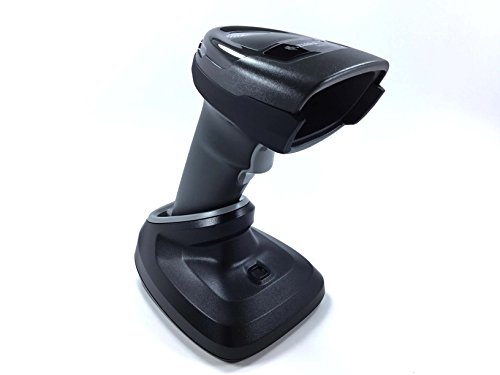
- Bluetooth kit includes cradle and battery
- Omnidirectional scanning
- Wi-Fi Friendly Mode
Best For: Checkout stations needing cordless convenience
Best Budget Laser Scanner

- 200 scans per second
- USB plug-and-play compatibility
- Configurable output settings
Best For: Basic 1D barcode work in shops and warehouses
Best with Extra Features
Alacrity 2D Industrial Barcode Scanner

- High-resolution sensor reads challenging 1D and 2D codes
- Works with printed and digital barcodes
- Shock- and dust-resistant with charging stand
Best For: Rugged everyday scanning at close range
Most Versatile Setup
Tera HW0009 Wireless Barcode Scanner

- Screen and keypad simplify setting adjustments
- Three connection modes: Bluetooth, 2.4G, and USB
- 2500mAh battery with charging cradle
Best For: Multi-device POS and inventory workflows
Simple Stand-Based Option
ScanAvenger 3-in-1 Barcode Scanner
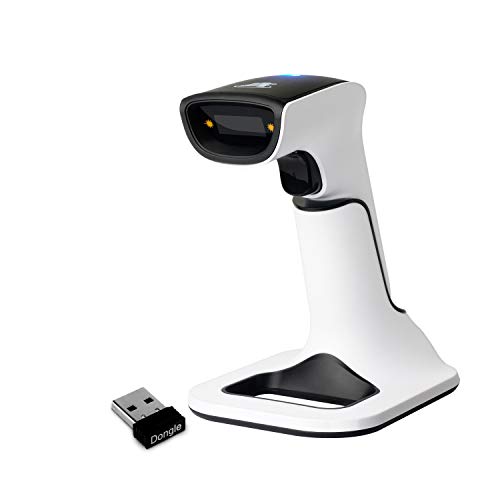
- Bluetooth, wireless, and USB connectivity
- Stand charges and wirelessly links the scanner
- No software or app installation required
Best For: Straightforward inventory and POS scanning
Best Rugged Wireless Pick – Tera 1D Wireless Barcode Scanner
If you need dependable barcode scanners for stockrooms, retail counters, or general inventory work, the Tera 1D scanner combines cordless range with a wired USB fallback. Its battery indicator, protective housing, and broad 1D compatibility make it a practical everyday option.
Best For: Retail, warehouse, and inventory tasks that require a durable wireless 1D scanner.
Pros:
- Offers 2.4G wireless and USB wired modes with transmission up to 328 feet in a barrier-free environment.
- Battery-level indicator helps track remaining charge, while the larger battery supports longer use and standby time.
- Reads many common 1D formats, including damaged, fuzzy, reflective, and smudged barcodes.
- Orange silicone protection helps resist scratches, friction, and drops from up to 6.56 feet; IP54 protection helps guard against dust.
Cons:
- Supports 1D barcodes rather than 2D or QR codes.
- Its larger handheld design may be less convenient than a pocket-sized scanner.
Choose this Tera model if durability, visible battery status, and long wireless range matter more than compact size or 2D scanning.
Best Pocket-Sized Option – Eyoyo Mini 1D Bluetooth Scanner
Among portable barcode scanners, the Eyoyo Mini stands out for its 35-gram pocket-friendly design and three connection modes. It is built for printed 1D codes and offers useful configuration features for mobile retail, library, warehouse, and inventory workflows.
Best For: Portable 1D scanning with laptops, phones, tablets, POS systems, and other compatible devices.
Pros:
- Supports Bluetooth, 2.4G wireless, and USB wired connections.
- Its compact 35 g design is easy to carry, with wireless ranges up to 98 feet in 2.4G mode and 164 feet in Bluetooth mode without barriers.
- Rechargeable battery provides up to 8 hours of continuous use and up to 10 days with the stated scanning scenario and auto-off feature.
- Supports storage mode, custom prefixes and suffixes, keyboard keys, continuous scanning, and adjustable or muted volume.
Cons:
- Only scans printed 1D barcodes; it does not support 2D or QR codes.
- It cannot scan codes displayed on phone or computer screens.
- Not compatible with Square POS or Square Register systems.
The Eyoyo is a strong fit when portability and flexible connectivity are priorities, provided your workflow uses printed 1D codes.
Best Hands-Free Choice – NetumScan Desktop 1D/2D Scanner
For counters and workstations, this NetumScan desktop barcode scanner removes the need to pick up a handheld reader. Its automatic omnidirectional scanning supports 1D, 2D, and QR codes, including codes shown on mobile or computer displays.
Best For: Hands-free scanning at retail counters, warehouses, bookstores, and USB-connected workstations.
Pros:
- Captures 1D, 2D, and QR barcodes from labels, paper, phones, and computer screens.
- Automatic sensing wakes the scanner from sleep when an item moves into position.
- Omnidirectional scanning and a non-slip base can support faster hands-free workflows.
- Plug-and-play USB setup works with Windows, Mac OS, and Linux; IP54 and anti-shock features add durability.
Cons:
- USB cable operation limits it to a fixed workstation.
- It is not compatible with Square, Clover, or Shopify.
- Desktop dimensions make it less suitable for mobile scanning.
This is the practical pick when speed and hands-free operation matter, especially for repeated scanning at a dedicated counter or desk.
Best Battery Life – Inateck Wireless 1D Barcode Scanner
The Inateck BCST-21 is one of the more convenient barcode scanners for extended wireless use, pairing a 2000mAh battery with Bluetooth, 2.4G, and USB connectivity. It is designed for frequent 1D scanning in warehouses, supermarkets, retail, logistics, and library settings.
Best For: High-use 1D scanning where long battery life and multi-device compatibility are important.
Pros:
- Rated for up to three months per charge under normal scanning frequency and up to one month with high-frequency use.
- Supports 2.4G wireless, Bluetooth, and USB wired modes across Windows, Mac OS, iOS, Android, iPad OS, and Linux.
- Laser scanning reads common 1D formats, including blurry, damaged, dirty, wrinkled, and distorted codes.
- The Inateck Office app supports scanner configuration, Bluetooth management, and battery monitoring.
Cons:
- It is limited to 1D barcode scanning.
- Its larger handheld form may be less portable than a mini scanner.
- Some configuration features depend on using the companion app.
If minimizing charging interruptions is your top priority, the Inateck offers an unusually long stated battery runtime along with broad connection and operating-system support.
Best Plug-and-Play 2D Scanner – Eyoyo EY-H2
If you need versatile barcode scanners for a checkout counter, inventory station, or office, the Eyoyo EY-H2 offers wired plug-and-play operation with broad 1D and 2D barcode support. It can also read codes from phone screens, making it useful for digital coupons, loyalty cards, and mobile payments.
Best For: Retail counters, convenience stores, warehouses, libraries, and other locations that need reliable USB scanning.
Pros:
- Reads common 1D and 2D formats, including QR, DataMatrix, and PDF417.
- Connects by USB without requiring drivers or additional software.
- Supports screen scanning for mobile coupons, digital wallets, and loyalty cards.
- Features a 5-foot drop-resistant ABS design and configurable prefixes, suffixes, and keyboard commands.
Cons:
- Some small, blurry, or dense PDF417 codes may not scan reliably.
- Not compatible with Square POS or Square Register systems.
- Wired operation limits mobility compared with Bluetooth models.
The EY-H2 is a practical choice when broad barcode compatibility and simple USB setup matter more than wireless freedom. Its screen-scanning capability gives it an advantage for modern retail workflows.
Best Wireless Retail Scanner – Zebra DS2278-SR
Among barcode scanners for busy checkout areas, the Zebra DS2278-SR stands out for its wireless Bluetooth design, included cradle, and ready-to-use configuration. Its omnidirectional imaging helps users scan without carefully aligning the barcode.
Best For: Retail checkout teams and workstations that benefit from wireless movement and quick, low-training scanning.
Pros:
- Bluetooth connectivity provides wireless scanning, with a cradle and USB cable included.
- Scans across a stated range of 0.5 to 14.5 inches.
- Omnidirectional scanning reduces the need to line up the imager.
- Wi-Fi Friendly Mode helps avoid channels shared with WLAN networks.
Cons:
- Requires battery charging and wireless setup compared with a basic corded scanner.
- The supplied information does not specify a scan rate or drop rating.
- Its wireless features may be unnecessary for a fixed scanning station.
The DS2278-SR is a strong fit when cordless convenience and easy scanning technique are priorities. It arrives pre-configured for common applications and can also be managed from compatible smartphones, tablets, or PCs.
Best Budget Laser Scanner – WoneNice WN3300
WoneNice USB Laser Barcode Scanner Wired Handheld Bar Code Scanner Reader Black
Check Price On AmazonFor straightforward barcode scanners that connect directly to a computer, the WoneNice WN3300 keeps things simple with USB plug-and-play operation and a 200-scan-per-second laser engine. It supports many common linear barcode formats and works with standard office software.
Best For: Small businesses, shops, warehouses, and basic point-of-sale or data-entry tasks using 1D barcodes.
Pros:
- Simple USB installation works with Windows, Mac, and Linux.
- Scans at up to 200 scans per second.
- Supports numerous 1D formats, including UPC, EAN, Code 39, and Code 128.
- Offers configurable prefix, suffix, and termination strings plus adjustable beep settings.
Cons:
- Laser scanning is intended for 1D barcodes and does not provide the supplied 2D capabilities of an imager.
- USB wired operation does not offer wireless flexibility.
- The listed scan angles may require more deliberate positioning than omnidirectional imaging.
The WN3300 is a sensible low-complexity option for businesses working primarily with traditional 1D labels. Its fast scan rate and configurable output settings make it useful for routine USB-based data entry.
Best with Extra Features – Alacrity 2D Industrial Barcode Scanner
For shoppers comparing barcode scanners for busy work areas, the Alacrity offers a high-resolution 2D scan engine with strong motion tolerance. It reads printed and screen-based barcodes, including labels that are dirty, partially damaged, shrink-wrapped, or poorly printed.
Best For: Users who want a rugged handheld scanner for flexible Bluetooth scanning and hands-free use with its wireless charging stand.
Pros:
- Reads 1D and 2D barcodes from labels, phones, and computer screens.
- Global Shutter Scan Sensor supports fast, accurate scanning with motion tolerance.
- Shock- and dust-resistant design with a wireless charging stand.
- Compatible with desktops, laptops, and smartphones.
Cons:
- Not designed for long-distance barcode reading.
- The supplied details identify Bluetooth connectivity but do not specify supported operating systems.
This is a practical choice when durability and difficult barcode reading matter more than extended scanning range. Consider another model if your workflow requires scanning from a distance.
Most Versatile Setup – Tera HW0009 Wireless Barcode Scanner
The Tera HW0009 stands out among barcode scanners for its built-in screen, programmable settings, and three connection options. It can scan common 1D and 2D formats, including PDF417 on driver’s licenses, while connecting by Bluetooth, 2.4G wireless, or USB.
Best For: Businesses needing broad device compatibility, long battery life, and customizable scanner settings for POS, inventory, or general data entry.
Pros:
- Screen and keypad let you adjust language, volume, connection options, and barcode storage settings.
- Supports Bluetooth, 2.4G wireless, and USB wired connections.
- 2500mAh battery and charging cradle support extended operation.
- Reads 1D, 2D, QR, PDF417, Data Matrix, Aztec, and other listed formats.
Cons:
- The scanner and cradle have a larger footprint than a basic handheld reader.
- The listed 2.4G range varies from 328 feet without barriers to 114 feet with obstacles.
With its screen, built-in 2.4G receiver, wide compatibility, and extensive format support, the HW0009 is the most adaptable option here. It is especially useful for teams that want to change settings without relying on a computer.
Simple Stand-Based Option – ScanAvenger 3-in-1 Barcode Scanner
The ScanAvenger SA9000 is a straightforward choice among barcode scanners for inventory, POS, and everyday data entry. Its stand charges the built-in battery and supports wireless transmission, while manual and auto-sense modes offer flexibility during scanning.
Best For: Users seeking a no-software-needed scanner that works with computers, mobile devices, and most POS systems.
Pros:
- Supports Bluetooth, wireless, and USB connections.
- Charging stand holds the scanner, charges it, and transmits wirelessly.
- Manual and auto-sense scan modes accommodate different workflows.
- Reads listed 1D and 2D formats, including QR, PDF417, Aztec, and Data Matrix.
Cons:
- Does not work with Maxicode.
- Not compatible with POS systems requiring proprietary hardware or direct app-level integration.
- The supplied details do not specify a wireless transmission range.
This model keeps setup simple because it requires no software or app installation. It is a sensible fit for standard scanning tasks, provided your POS system does not require proprietary integration and you do not need Maxicode support.
How We Picked These Barcode Scanners
We selected models that represent the main needs of small businesses, retailers, warehouses, offices, and home sellers. Our comparison considers barcode compatibility, wired and wireless connectivity, battery design, portability, scanning range, ergonomics, and useful accessories such as stands or charging cradles.
We also separated basic 1D laser readers from 2D imaging scanners. That distinction matters because newer products, mobile payment screens, and shipping labels often use QR codes or other two-dimensional formats that a traditional laser scanner cannot read.
Quick Comparison
| Scanner type | Best suited for | Main advantage |
|---|---|---|
| Wired USB | Checkout desks and fixed workstations | Simple setup with no battery to charge |
| Bluetooth handheld | Inventory and mobile workflows | Freedom to scan away from a computer |
| 2.4GHz wireless | Retail counters and offices | Dedicated receiver and reliable local connection |
| 2D imaging scanner | QR codes, mobile screens, and modern labels | Reads both 1D and 2D formats |
| Desktop scanner | Hands-free scanning | Faster repetitive scanning at a counter |
Key Buying Factors for Barcode Scanners
1D or 2D Compatibility
Choose a 1D model if you only scan traditional linear product barcodes. Select a 2D scanner if you need QR codes, coupons, shipping labels, driver’s licenses, or barcodes displayed on phones. A 2D model is usually the more flexible long-term choice.
Connection and Range
USB scanners are dependable and typically easiest to configure. Bluetooth works well with tablets, phones, and laptops, while 2.4GHz receivers are convenient for computers that may not have Bluetooth. Check the stated range, but expect walls, shelving, and interference to reduce real-world distance.
Battery and Charging
For occasional use, a compact rechargeable scanner may be sufficient. Busy inventory teams should look for higher-capacity batteries, charging stands, battery indicators, or a wired fallback mode. A cradle can keep a scanner ready while also providing a consistent home between scans.
Ergonomics and Scanning Style
Handheld units are versatile, but desktop scanners are faster when items pass repeatedly across a counter. Consider weight, trigger comfort, stand stability, and whether the scanner can automatically detect and read a code without a button press.
Who Should Buy Which Barcode Scanners?
- For a basic checkout station: Choose a wired USB 1D scanner for low cost, straightforward setup, and dependable daily scanning.
- For QR codes and mobile displays: Buy a 2D imaging scanner, especially if customers present coupons, tickets, or payment codes on a phone.
- For stocktaking and inventory walks: Choose a Bluetooth handheld with a comfortable grip and a battery sized for a full work session.
- For a busy retail counter: Consider a scanner with a stand, automatic scanning, or a desktop form factor to reduce repetitive trigger use.
- For warehouses and demanding environments: Prioritize durable construction, longer wireless range, dependable charging, and compatibility with the software used for inventory control.
Before buying, confirm that the scanner supports your operating system and application, uses the barcode formats your business requires, and can be configured for suffixes such as Enter or Tab. Those small compatibility details often matter as much as scan speed.
