The best portable RAID enclosures turn separate hard drives or SSDs into a flexible storage system for backups, media libraries, file transfers, and workstation expansion. The right model depends on drive size, RAID support, connection speed, portability, and how much capacity you need.
We’ve compared 10 diskless and multi-bay options, from compact dual-drive units to high-capacity four- and five-bay enclosures, to help you choose a practical fit for your hardware and workflow.
Best 10 Portable Raid Enclosures Picks for 2026
Best High-Speed Two-Bay Pick

- USB 3.2 Gen 2 up to 10Gbps
- RAID 0, 1, JBOD, and Single modes
- Supports two drives up to 44TB total
Best For: Flexible two-drive direct-attached storage
Best Four-Bay Thunderbolt Option

- Four bays for 3.5-inch or 2.5-inch drives
- Thunderbolt 3 up to 40Gb/s
- Supports RAID 0, 1, 4, 5, and 10
Best For: High-throughput Thunderbolt storage arrays
Best Lightweight Dual-Drive Enclosure
Addonics Portable RAID Enclosure

- Compact dual-drive enclosure
- Measures 5.24 × 3.27 × 1.3 inches
- Weighs 7.2 ounces
Best For: Portable, space-conscious dual-drive setups
Best Four-Bay USB RAID Value

- Four 3.5-inch SATA drive bays
- Hardware RAID 0, 1, 5, JBOD, and individual disks
- USB Type-C for Windows, macOS, and Linux
Best For: Four-drive USB storage and compatible QNAP expansion
Best High-Capacity Pick
ORICO 5-Bay Hardware RAID Enclosure

- Five-bay design supports up to 110TB
- Hardware RAID with eight operating modes
- 150W power supply and active cooling
Best For: Large backups, video editing, and media libraries
Best Compact Dual-Drive Pick
Vantec Nexstar GX RAID Enclosure

- Compact two-drive 2.5-inch design
- Supports Individual, RAID 0, and RAID 1
- USB 3.0 with UASP and auto RAID 1 rebuild
Best For: Portable dual-drive storage for laptops and small workspaces
Best Five-Bay RAID 5 Pick
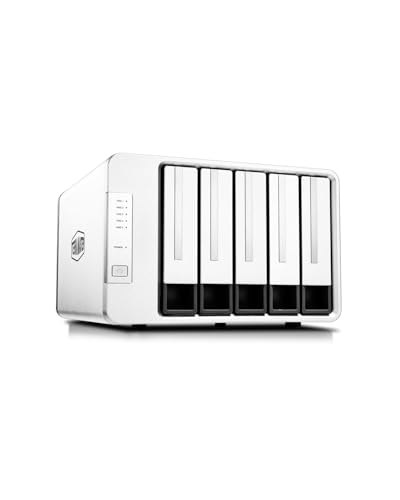
- Hardware RAID 5, 0, 1, 10, and Single modes
- Five bays support up to 120TB
- Tool-free bays and hot-spare support
Best For: Cross-platform RAID 5 storage expansion and backups
Stable Dual-Bay RAID
CENMATE 2-Bay Aluminum RAID Enclosure

- Four RAID modes with ASM1156R chip
- Supports 2.5-inch and 3.5-inch SATA drives
- USB A/C 3.0 and built-in cooling fan
Best For: Flexible two-drive desktop storage
High-Capacity Four-Drive Storage
CENMATE 2-Bay RAID×2 Enclosure

- Four-drive design supports up to 80TB
- Works with 2.5-inch and 3.5-inch SATA drives
- Four RAID modes and USB A/C 3.0
Best For: High-capacity external desktop storage
Best High-Speed Two-Bay Pick – TerraMaster D2-320
The TerraMaster D2-320 is a practical choice for shoppers comparing portable raid enclosures with two SATA drives. It uses USB 3.2 Gen 2 with speeds up to 10Gbps and supports RAID 0, RAID 1, JBOD, and Single modes. The enclosure is diskless, so drives must be purchased separately.
Best For: Users who want a flexible two-drive DAS for fast transfers, mirrored storage, or large-capacity desktop backups.
Pros:
- USB 3.2 Gen 2 Type-C connection with up to 10Gbps transmission.
- Supports RAID 0, RAID 1, JBOD, and Single configurations.
- Accepts two 3.5-inch or 2.5-inch SATA HDDs or SSDs, up to 44TB total based on two 22TB drives.
- Tool-free trays and temperature-controlled fan simplify installation and cooling.
Cons:
- It is a DAS rather than a network-attached storage system.
- Drives are not included.
- The enclosure requires an external power adapter.
With broad RAID support, tool-free installation, and substantial two-drive capacity, the D2-320 is a well-rounded portable raid enclosure for direct-connected storage. Its usefulness depends on having a computer with a compatible USB connection and supplying your own drives.
Best Four-Bay Thunderbolt Option – OWC ThunderBay 4
The OWC ThunderBay 4 is designed for buyers who need a four-drive portable raid enclosure with Thunderbolt 3 connectivity. It accepts 3.5-inch or 2.5-inch drives without an adapter, offers dual Thunderbolt 3 ports, and reaches up to 1527MB/s of sustained performance. It ships without storage installed.
Best For: Mac and PC users with Thunderbolt 3 or compatible USB-C Thunderbolt systems who need expandable four-drive storage.
Pros:
- Four-bay design supports both 3.5-inch and 2.5-inch drives.
- Dual Thunderbolt 3 ports provide up to 40Gb/s connectivity.
- Supports user-configurable RAID 0, 1, 4, 5, and 1+0 (10).
- Aluminum chassis is designed for quiet operation and heat dissipation.
Cons:
- It is a 0TB enclosure, so drives must be added separately.
- Thunderbolt connectivity may be less broadly compatible than standard USB.
- The four-bay chassis is relatively heavy at 3.9 kg.
The ThunderBay 4 stands out when high throughput and multiple RAID choices matter more than minimum size or weight. Its four bays provide room to build a larger array, but buyers should verify that their computer supports Thunderbolt.
Best Lightweight Dual-Drive Enclosure – Addonics Portable RAID Enclosure
The Addonics Portable Dual Drive RAID Enclosure is a compact option for shoppers seeking portable raid enclosures in a lightweight dual-drive format. Its listed dimensions are 5.24 by 3.27 by 1.3 inches, and it weighs 7.2 ounces. The supplied information identifies it as an enclosure but does not specify supported RAID modes, interfaces, or whether drives are included.
Best For: Buyers prioritizing a small, lightweight dual-drive enclosure and willing to confirm compatibility details before purchase.
Pros:
- Dual-drive portable RAID enclosure design.
- Compact dimensions suit space-conscious setups.
- Listed weight of just 7.2 ounces improves portability.
Cons:
- The supplied notes do not specify RAID modes or transfer speed.
- Drive compatibility and included accessories are not detailed.
- Interface information is not provided.
The Addonics model is appealing primarily for its small footprint and low weight. Because the available specifications are limited, check the current product listing carefully for drive type, interface, RAID functionality, and included components before committing.
Best Four-Bay USB RAID Value – QNAP TR-004
QNAP TR-004 4 Bay USB Type-C Direct Attached Storage (DAS) with hardware RAID (Diskless)
Check Price On AmazonThe QNAP TR-004 is a four-bay USB Type-C DAS for Windows, macOS, and Linux users comparing portable raid enclosures. It supports hardware RAID 0, 1, 5, JBOD, and individual disks, accepts four 3.5-inch SATA drives, and can also serve as external storage or expand compatible QNAP NAS systems. It is diskless.
Best For: Users who need a four-drive USB enclosure for computer storage, backups, or compatible QNAP NAS expansion.
Pros:
- Four drive bays support 3.5-inch SATA drives.
- Hardware RAID supports RAID 0, 1, 5, JBOD, and individual disks.
- Works with Windows, macOS, and Linux through USB Type-C.
- Includes a USB Type-C to Type-A cable and lockable drive bays.
Cons:
- Drives are not included.
- Its USB 3.0 connection is rated at 5Gbps, below newer 10Gbps USB enclosures.
- QNAP NAS expansion has model and storage-pool limitations.
The TR-004 offers useful four-bay capacity and hardware RAID at a comparatively straightforward USB DAS level. It is a strong fit for direct computer storage, while QNAP NAS owners should review the stated compatibility and migration restrictions first.
Best High-Capacity Pick – ORICO 5-Bay Hardware RAID Enclosure
The ORICO 5-bay enclosure is a practical choice for shoppers seeking portable raid enclosures with substantial desktop storage capacity. Its hardware RAID controller supports multiple configurations, while the built-in 150W power supply and cooling system are designed for stable multi-drive operation.
Best For: Large backup projects, video editing, and media libraries that need up to five SATA drives.
Pros:
- Supports RAID 0, 1, 3, 5, 10, JBOD, Clone, and Clear modes.
- Accommodates five 2.5-inch or 3.5-inch SATA HDDs or SSDs, with up to 110TB total capacity based on five 22TB drives.
- Includes a 150W internal power supply, 80mm fan, and aluminum shell for sustained operation.
- Works with Windows, Mac, and Linux through USB 3.0, with stated transfer rates up to 230MB/s.
Cons:
- Its five-bay desktop design is less compact than a small two-drive enclosure.
- USB 3.0 is older than newer USB generations.
Choose the ORICO when capacity and RAID flexibility matter more than minimal size. The broad mode selection and strong power and cooling provisions make it a versatile workstation storage enclosure.
Best Compact Dual-Drive Pick – Vantec Nexstar GX RAID Enclosure
Vantec Nexstar GX USB 3.0 Dual 2.5" SATA SSD/HDD RAID Enclosure, Black (NST-272S3-BK)
Check Price On AmazonThe Vantec Nexstar GX is a compact option among portable raid enclosures, supporting two 2.5-inch SATA SSDs or hard drives. It offers Individual, RAID 0, and RAID 1 modes in a lightweight aluminum enclosure with USB 3.0 connectivity.
Best For: Laptop users and compact desktop setups needing mirrored or high-speed dual-drive storage.
Pros:
- Supports Individual, RAID 0, and RAID 1 configurations.
- Compatible with 2.5-inch SATA I, II, and III SSDs or HDDs.
- Compact aluminum housing measures 4.72 by 3.15 by 0.98 inches and weighs 10.56 ounces.
- Includes UASP support, USB 3.0 speeds up to 5Gbps, and automatic RAID 1 rebuilding.
Cons:
- Only supports two drives and is limited to 2TB per drive according to the supplied specifications.
- Requires the included 5V/2A AC adapter for power.
- Does not support the broader RAID mode selection found on five-bay models.
The Nexstar GX is best when portability and a small footprint take priority. Its dual-drive RAID 1 option can add redundancy, while RAID 0 supports users who prefer speed over mirroring.
Best Five-Bay RAID 5 Pick – TERRAMASTER D5-310 Enclosure
The TERRAMASTER D5-310 is a diskless five-bay enclosure for shoppers comparing portable raid enclosures with hardware RAID and broad operating-system support. It offers RAID 5, 0, 1, 10, and Single modes, plus tool-free bays and a hot-spare feature for supported RAID configurations.
Best For: Multi-drive storage expansion and users who want RAID 5 capability with Windows, macOS, or Linux.
Pros:
- Dedicated hardware RAID control supports RAID 5, 0, 1, 10, and Single modes.
- Supports five 3.5-inch or 2.5-inch SATA HDDs or SSDs, with up to 120TB total capacity based on five 24TB drives.
- Includes tool-free drive bays, hot-spare support, temperature-controlled fans, and power-on recovery.
- Provides USB 3.1 Gen 1 connectivity with stated actual read/write speeds up to 220MB/s.
Cons:
- Drives are not included, so the total setup cost depends on the disks purchased.
- Its five-bay enclosure is relatively large and weighs 4.9 pounds.
- The listed USB interface is limited to 5Gbps.
The D5-310 stands out for users who specifically want hardware RAID 5 and substantial expansion room. Its five bays, hot-spare support, and cross-platform compatibility make it a strong fit for structured backup and storage workflows.
Stable Dual-Bay RAID – CENMATE 2-Bay Aluminum RAID Enclosure
For shoppers comparing portable raid enclosures, this CENMATE dual-bay model offers a practical way to use either 2.5-inch or 3.5-inch SATA HDDs and SSDs. Its ASM1156R chip, USB A/C 3.0 connectivity, tool-free design, and built-in fan suit desktop or laptop storage setups.
Best For: Individuals and small businesses needing a flexible two-drive enclosure with basic RAID options.
Pros:
- Supports RAID 0, RAID 1, Normal, and JBOD modes.
- Accepts both 2.5-inch and 3.5-inch SATA drives, up to 20TB per drive.
- Includes USB-A and USB-C 3.0 connectivity and plug-and-play compatibility.
- Aluminum construction and a built-in 2-inch cooling fan help manage heat.
Cons:
- The fan produces approximately 40–50 decibels of noise.
- RAID setup can result in data loss, and the RAID functionality is not supported by Mac OS software.
- USB 3.0 limits the listed transfer rate to 5Gbps.
This enclosure is a straightforward choice when drive-size flexibility matters more than advanced connectivity. Its four modes and dual-interface cable support make it versatile, though noise-sensitive users should account for the cooling fan.
Portable Flash Workflow – ORICO 4-Bay 2.5-Inch RAID Enclosure
Among portable raid enclosures, the ORICO 4-bay all-flash model stands out for users working with compact 2.5-inch drives. It combines seven RAID modes with USB 3.2 connectivity, expansion ports, and a lightweight solid-state-oriented design suited to video and photography workflows.
Best For: Video editors, photographers, and mobile creators using 2.5-inch SSDs or HDDs.
Pros:
- Offers RAID 0, 1, 3, 5, 10, JBOD, and CLEAR modes.
- Supports up to 8TB per drive and up to 40TB across the four bays.
- Provides two USB 3.2 10Gbps ports plus SD and TF card slots.
- Its compact, lightweight design is easier to carry in a backpack or camera bag.
Cons:
- Supports only 2.5-inch drives, not 3.5-inch HDDs.
- The listed 5Gbps SATA connection rate may be lower than the enclosure’s 10Gbps USB interface capability.
- Drive capacities and total storage depend on the installed SSDs or HDDs.
The ORICO is the most travel-oriented option here, especially for creators who need card access and multiple RAID configurations. Its 2.5-inch-only design makes it less suitable for users with larger desktop drives.
High-Capacity Four-Drive Storage – CENMATE 2-Bay RAID×2 Enclosure
This CENMATE combines two two-bay RAID units in one enclosure, making it a useful option among portable raid enclosures for users who need four-drive capacity. It supports 2.5-inch and 3.5-inch SATA drives, USB A/C 3.0, and independent RAID functionality with cooling fans.
Best For: Users building a high-capacity external storage system from up to four SATA drives.
Pros:
- Supports up to 80TB total, with up to 20TB per drive.
- Accepts both 2.5-inch and 3.5-inch HDDs and SSDs.
- Provides RAID 0, RAID 1, Normal, and JBOD modes.
- Includes USB-A and USB-C 3.0 connectivity and aluminum construction.
Cons:
- Cooling fans produce approximately 40–50 decibels of noise.
- Transfer speeds are listed at up to 5Gbps over USB 3.0.
- RAID configuration may cause data loss, and Mac OS does not include RAID software support.
With twice the bay count of a typical two-drive enclosure, this model prioritizes capacity and drive flexibility. It is a strong fit for desktop storage expansion, provided the fan noise and USB 3.0 limit fit your setup.
How We Picked These Portable Raid Enclosures
We evaluated these Portable Raid Enclosures by comparing bay count, supported drive types, RAID functionality, interface speed, operating flexibility, cooling, installation convenience, and expansion potential. We also considered whether each enclosure suits travel, desktop use, creative work, backup duties, or larger capacity requirements.
Because most models are diskless, compatibility matters. Confirm the enclosure supports your existing 2.5-inch or 3.5-inch SATA drives, SSDs, desired RAID mode, and host computer connection before buying.
Quick Comparison
| Best For | Look For |
|---|---|
| Travel and small backups | Compact two-bay design, low weight, and USB connectivity |
| Creative workstations | Thunderbolt or high-speed USB and multiple drive bays |
| Large media libraries | Four or five bays, high maximum capacity, and effective cooling |
| Mixed drive collections | Support for both 2.5-inch and 3.5-inch SATA drives |
| Simple drive protection | Hardware RAID modes and an accessible configuration process |
Key Buying Factors for Portable Raid Enclosures
Bay Count and Capacity
Two-bay enclosures are easier to transport and often sufficient for mirrored backups or modest storage pools. Four- and five-bay models provide more capacity, additional RAID options, and room to expand, but they take up more desk space and may require stronger cooling.
RAID Features
RAID 0 can increase performance and combine capacity, while RAID 1 mirrors data for improved drive-failure protection. Larger enclosures may support RAID 5, RAID 10, or independent disks. RAID is not a substitute for a separate backup, so keep another copy of important files.
Connection and Speed
USB 3.0 and USB Type-C are practical for general storage, but the connector does not automatically determine performance. The enclosure, cable, computer port, and installed drives all affect real-world speeds. Thunderbolt models are better suited to demanding video, photo, and professional storage workflows when the host system supports them.
Drive Compatibility and Cooling
Check whether the enclosure accepts 2.5-inch drives, 3.5-inch drives, or both. SSDs run quietly and efficiently, while larger hard drives offer more capacity per dollar. Fans, ventilation, and tool-free trays can make a noticeable difference during sustained transfers.
Who Should Buy Which Portable Raid Enclosures?
Choose a compact dual-bay enclosure if you need portable backups, a mirrored work drive, or a straightforward way to reuse a pair of SATA drives. Pick a four-bay model for a balance of capacity, redundancy, and desktop flexibility. A five-bay enclosure is the better choice for growing media collections, multiple RAID configurations, or frequent expansion.
For demanding creative work, prioritize Thunderbolt or the fastest interface your computer supports. For ordinary backups and file storage, a dependable USB enclosure with suitable RAID options is usually the better value. Whichever model you select, match the enclosure to your drives and maintain an independent backup of irreplaceable data.
