If you need clean, searchable digital copies of bound books, manuals, or records, the right scanner can save hours of rework. The best book scanners for archiving balance speed, image quality, OCR accuracy, and gentle handling of fragile pages.
In this roundup, we focus on models that are practical for long-term archiving, from overhead scanners to flatbeds and book-friendly document cameras.
Best 10 Book Scanners for Archiving Picks for 2026
Fast Overhead Book Scanner

- Scans in about 2 seconds per page
- Outputs JPG, Word, PDF, and searchable PDF
- OCR supports 180+ languages
Best For: Fast book and document archiving with searchable files
Large-Format Archive Scanner
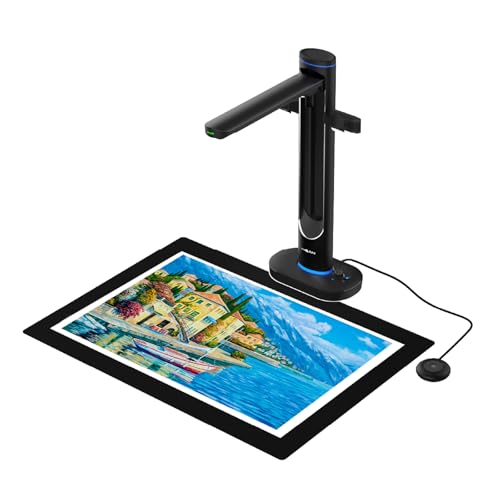
- Captures books and documents up to A2 size
- Dual 48MP cameras with up to 600 DPI
- OCR and text-to-speech improve accessibility
Best For: Oversized, fragile, or bound materials in archives
Flatbed Book Preservation Scanner

- BookMaker software helps organize scans
- OCR enables editable, searchable files
- Flatbed design suits careful single-page capture
Best For: Organized archiving of books and reference materials
Portable Teaching Scanner

- One-key automatic correction for skewed pages
- OCR exports to Word or TXT with high accuracy
- Foldable aluminum body for easier portability
Best For: Portable scanning, teaching, and lightweight archiving
Overhead Archiving Scanner
ScanSnap SV600 Overhead Book and Document Scanner

- Scans books and newspapers without cutting them
- Auto Book Correction helps flatten curved pages
- Page Turning Detection supports hands-free scanning
Best For: Archiving fragile books and mixed paper items
Portable Book Scan Tool
CZUR Shine Ultra Smart Portable Document Scanner

- About 1-second-per-page scanning speed
- Patented flattening for curved book pages
- OCR supports 180+ languages
Best For: Quick digitization of thin books and flat papers
Large Format Archiving Scanner
A2 Book Scanner with 23MP High-Resolution Camera
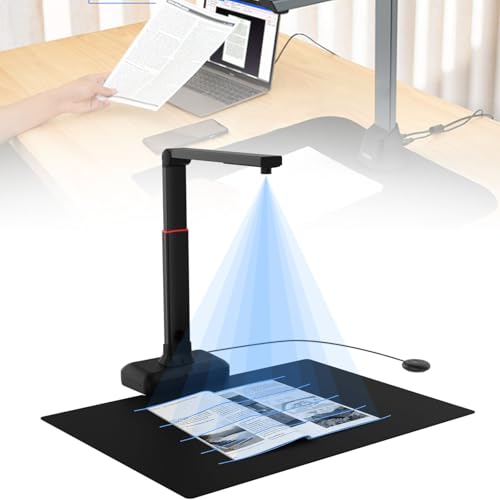
- 23MP camera for detailed large-format captures
- Automatic continuous scanning with page detection
- OCR supports searchable PDFs and editable formats
Best For: Oversized books, manuscripts, newspapers, and maps
Professional Precision

- 26MP A3 scanning for books and documents
- Software adds OCR, curve flattening, and page-turn detection
- LED lamp, laser guide, hand switch, and foot pedal included
Best For: Libraries, offices, and schools archiving mixed materials
High-Detail Archiving Workhorse
VIISAN K48 48MP Overhead Scanner

- 48MP overhead scanning with up to 600 DPI
- AI page flattening and auto page splitting reduce cleanup
- OCR and 4K document-camera mode add flexibility
Best For: Searchable archives, study materials, and classroom use
Practical A3 Archiving Solution

- A3 overhead design for books and oversized pages
- 16MP capture with up to 300 DPI
- Anti-glare LED lighting and OCR support
Best For: Libraries and home archivists scanning large-format materials
Fast Overhead Book Scanner – CZUR Aura Pro
If you want a book scanners for archiving setup that moves quickly, the CZUR Aura Pro is built for high-speed digitizing of books and documents. It scans in about 2 seconds per page, creates JPG, Word, PDF, and searchable PDF files, and uses laser-based page flattening to improve curved book pages.
Best For: Fast archiving of books and documents where OCR, speed, and curved-page correction matter.
Pros:
- Very fast 2-second-per-page scanning for efficient archiving.
- Supports JPG, Word, PDF, and searchable PDF output.
- OCR handles 180+ languages for broad text recognition support.
- Laser line technology helps flatten curved book pages accurately.
Cons:
- Thai, Hebrew, and Arabic are not currently supported in OCR.
- Best suited to USB-connected desktop use rather than portable scanning.
- Uses a camera-style overhead workflow, which may take setup time for some users.
For archiving projects that prioritize speed and searchable output, this model is a practical all-around choice. Its smart lighting and AI-assisted processing help reduce friction when scanning mixed book and document batches.
Large-Format Archive Scanner – VIISAN S48 Duo
The VIISAN S48 Duo is a strong option for book scanners for archiving when you need to handle oversized materials without flattening them. Its overhead design captures books, manuscripts, maps, and documents up to A2 size, while dual 48MP cameras and built-in AI help produce detailed, cleaner scans.
Best For: Archiving oversized books, bound materials, and library items that should not be pressed flat.
Pros:
- Overhead A2-capable design protects fragile pages and bindings.
- Dual 48MP cameras deliver detailed scans up to 600 DPI.
- AI tools help flatten pages, remove finger marks, and clean backgrounds.
- OCR plus text-to-speech adds searchable and accessible output options.
Cons:
- Requires USB connection and desktop setup.
- Heavier and less portable than compact document cameras.
- Minimum system requirements may be a consideration for older computers.
If your archive includes large-format or delicate bound materials, this scanner is designed for that workflow. It combines preservation-friendly capture with software features that reduce editing and improve usability.
Flatbed Book Preservation Scanner – Plustek OpticBook 4900
For book scanners for archiving that focus on careful page capture and organization, the Plustek OpticBook 4900 takes a flatbed approach with bundled BookMaker software. It supports books, magazines, handwritten notes, and reference documents, while OCR and file sorting tools help turn scans into organized digital records.
Best For: Archiving books and reference materials that need organized filing and searchable text.
Pros:
- Includes BookMaker software for organizing books and reference documents.
- OCR supports editable formats and full-text search.
- Flatbed scanning is useful for controlled capture of single pages.
- Works with both Windows and Mac systems.
Cons:
- Single-sheet flatbed workflow is slower than overhead scanners.
- Lower sheet capacity makes batch processing less efficient.
- Not designed for large-format overhead capture.
This model makes sense when organization is as important as scanning quality. It is especially useful for smaller archival tasks where you want searchable files and a simple filing structure.
Portable Teaching Scanner – NetumScan 13MP Book Camera
The NetumScan 13MP Book Document Camera is a flexible pick for book scanners for archiving when portability and easy operation matter. It supports A3/A4 capture, automatic skew correction, OCR to Word or TXT, and live projection, making it useful for scanning as well as presentation tasks.
Best For: Portable archiving and classroom-style scanning where quick setup and easy sharing matter.
Pros:
- One-key automatic correction helps fix skewed images quickly.
- OCR converts scans to editable text with claimed 98%+ accuracy.
- Supports A3/A4 capture and multiple output formats.
- Foldable aluminum body makes it easier to carry and store.
Cons:
- Resolution is lower than some premium archival scanners.
- Best suited to computer-connected use over USB.
- Designed more as a document camera than a dedicated archive workstation.
This is a practical choice for users who need scanning plus presentation features in one device. It works well for lighter archiving jobs, classroom content, and mixed document workflows.
Overhead Archiving Scanner – ScanSnap SV600 Overhead Book and Document Scanner
If you need a practical option for book scanners for archiving, the ScanSnap SV600 is built for scanning books, newspapers, magazines, and other delicate materials without cutting them apart. Its overhead design, Auto Book Correction, and Page Turning Detection make it a solid fit for preserving pages while keeping the workflow fairly hands-off.
Best For: Archiving books and mixed paper materials without damaging originals.
Pros:
- Scans books, newspapers, magazines, and documents directly without cutting them
- Auto Book Correction helps flatten curve distortion for cleaner page captures
- Multi Document Detection crops and rotates multiple items in one scan
- Page Turning Detection and Time Mode support more flexible scanning sessions
Cons:
- Only one-sheet capacity, so it is not built for high-volume sheet feeding
- Uses USB connection, so it is a desktop-oriented setup
- Designed for books and documents, not a general-purpose batch scanner
For users focused on preserving fragile originals, the SV600 offers a dependable overhead workflow with useful correction tools. It is especially appealing when the priority is safe archiving rather than fast automatic feeding.
Portable Book Scan Tool – CZUR Shine Ultra Smart Portable Document Scanner
For book scanners for archiving that need portability and speed, the CZUR Shine Ultra is aimed at thin books, flat papers, and document capture. It scans in about one second per page, supports OCR in 180+ languages, and includes patented flattening technology for curved book pages, making it useful for quick digitization work.
Best For: Fast scanning of thin books and flat documents with OCR support.
Pros:
- About 1-second-per-page scanning for fast capture
- Patented flattening technology helps correct curved book pages
- OCR supports 180+ languages for searchable text workflows
- Lightweight, foldable design with 2-level height adjustment
Cons:
- Best suited to thinner books; thicker books are better handled by the ET series
- Not compatible with Android or iOS
- Works with flat papers and A3/A4-sized objects, so it is less specialized for oversized archival materials
The Shine Ultra is a strong pick if you want a compact scanner that moves quickly and includes useful OCR tools. Its biggest advantage is efficient digitization, though it is more limited for thicker bound volumes.
Large Format Archiving Scanner – A2 Book Scanner with 23MP High-Resolution Camera
This A2 book scanner is designed for archiving and digitization when you need large-format capture for journals, manuscripts, newspapers, or maps. Its 23MP camera, automatic page-change detection, digital flattening, and OCR features make it a capable choice for detailed preservation work.
Best For: Large-format archiving of books, manuscripts, newspapers, and maps.
Pros:
- 23MP high-resolution camera supports clear large-format scanning
- Automatically detects page changes and scans continuously
- Digital flattening and edge repair improve document presentation
- OCR can create searchable PDFs and editable text formats in 100+ languages
Cons:
- Bulky A2-style setup is less portable than smaller scanners
- Requires USB connection and desktop use
- Primarily aimed at archiving and digitization rather than casual scanning
If your archive includes oversized or detail-heavy originals, this model is built with that use case in mind. It combines high resolution with correction features that help make captured pages more usable for long-term records.
Professional Precision – Innex DS200 26MP Book Scanner
If you want book scanners for archiving that balance detail, speed, and flexibility, the Innex DS200 is built for everyday digitization work. Its 26MP capture and A3 support make it a practical choice for books, documents, photos, and other materials that need clear digital copies.
Best For: Libraries, offices, and schools that need a versatile overhead scanner for books and mixed archiving tasks.
Pros:
- Up to 26MP resolution with A3 support for detailed captures
- Innex Scan software includes curve flattening, OCR, auto-cropping, finger removal, and page-turn detection
- LED lamp, laser guide, hand switch, and foot pedal support flexible scanning workflows
- Also handles name cards, photos, barcodes, QR codes, and ID cards
Cons:
- Requires a Windows or macOS setup
- Listed resolution is 300 dpi in the details, so buyers should compare workflow needs carefully
The DS200 is a strong all-around option if your archiving projects include more than just books. It is designed to make bound and flat-material scanning more efficient without adding much setup complexity.
High-Detail Archiving Workhorse – VIISAN K48 48MP Overhead Scanner
For book scanners for archiving that need high capture quality, the VIISAN K48 is built around a 48MP overhead camera and up to 600 DPI scanning. It is aimed at books, reports, worksheets, and archive files where clear text and fast cleanup matter.
Best For: Users who want a high-resolution overhead scanner for searchable archives, study materials, and presentation use.
Pros:
- 48MP capture with up to 600 DPI for detailed pages
- AI-assisted page flattening and automatic page splitting help reduce cleanup
- OCR support creates searchable PDFs and editable digital documents
- Also works as a 4K@30fps USB document camera for teaching and review
Cons:
- Heavier than some competing desktop scanners at 2.8 kg
- Best suited to a stationary Windows or Mac setup
The K48 stands out when scan quality is the top priority and you want fewer manual edits after capture. Its document-camera function also adds value for classrooms or offices that need one device for multiple tasks.
Practical A3 Archiving Solution – VIISAN DL16 A3 Book Scanner
If you need book scanners for archiving without moving to a higher-cost high-resolution model, the VIISAN DL16 offers a straightforward A3 overhead setup. Its 16MP camera, OCR support, and anti-glare lighting make it a solid fit for bound books, large documents, artwork, and other materials that need clean overhead capture.
Best For: Libraries, home archivists, and offices that need an A3 scanner for books and oversized pages.
Pros:
- A3 overhead format handles books, sheet music, artwork, and large documents
- 16MP camera with up to 300 DPI for clear digital storage
- Anti-glare LED lighting helps reduce shadows on glossy or reflective pages
- OCR support helps create searchable files for archiving and reference
Cons:
- Lower resolution than the higher-end 48MP option in this roundup
- Windows and Mac compatibility means it is best used at a dedicated computer
The DL16 is a sensible choice if you need dependable overhead scanning for larger materials and want a simpler, more affordable archiving workflow. It focuses on practical capture quality rather than extra features.
How We Picked Book Scanners for Archiving
We prioritized scanners that can produce readable, searchable files with minimal page curvature, glare, or cropping issues. For archiving, that means looking closely at optical quality, OCR support, flat-field capture, and software that helps organize finished files. We also favored models that are easy to use repeatedly, since archival work often involves large batches.
Quick Comparison
Overhead models are usually the fastest choice for bound materials and larger books, while flatbeds can deliver very consistent results on smaller volumes. High-resolution camera-based units often offer the best mix of speed and flexibility, but their output depends more on lighting, alignment, and software correction. If you need the smoothest workflow, look for page-flattening features and strong text recognition.
Key Buying Factors for Book Scanners for Archiving
Resolution and Real-World Detail
Higher advertised resolution can help, but the more important question is whether text stays sharp across the page. For archival use, readable small type, clean margins, and accurate capture of illustrations matter more than headline specs alone.
OCR and File Handling
OCR turns scans into searchable documents, which is essential for archives, research libraries, and office records. Helpful software may also sort files, auto-crop pages, straighten images, and export to common formats such as PDF or searchable PDF.
Page Flattening and Glare Control
Book spines, shadows, and glossy pages can reduce scan quality. Features like auto page flattening, anti-glare lighting, and overhead capture help preserve more of the page without forcing the book completely flat.
Book Size and Workflow Speed
Choose a scanner that fits your largest typical source material. A3 support is useful for many books and magazines, while larger-format options make sense for oversized documents. If you are scanning many pages, speed and ease of setup become especially important.
Who Should Buy Which Book Scanners for Archiving?
Choose an overhead scanner if you archive bound books regularly and want faster, less damaging scanning. Pick a flatbed if you need dependable results for smaller books, photos, or mixed media. If you want a flexible, space-saving setup, a document-camera style scanner can be a strong middle ground for home offices, classrooms, and small archives. For the most demanding archival work, prioritize models with strong OCR, even lighting, and robust software over resolution alone.
